
Adaptive Capability
Comparative Adaptive Capability provides leaders with the insights they need to build organizational infrastructure for thriving through continuous transformation in an environment of constant change and volatility.
Created by:

Kelly Brogdon Geyer, CCMP
This assessment is based on 20+ years of enterprise transformation experience
Kelly Brogdon Geyer's extensive work leading enterprise transformations across global organizations has revealed that transformation success depends less on individual change initiatives and more on the organization's underlying adaptive capability infrastructure.
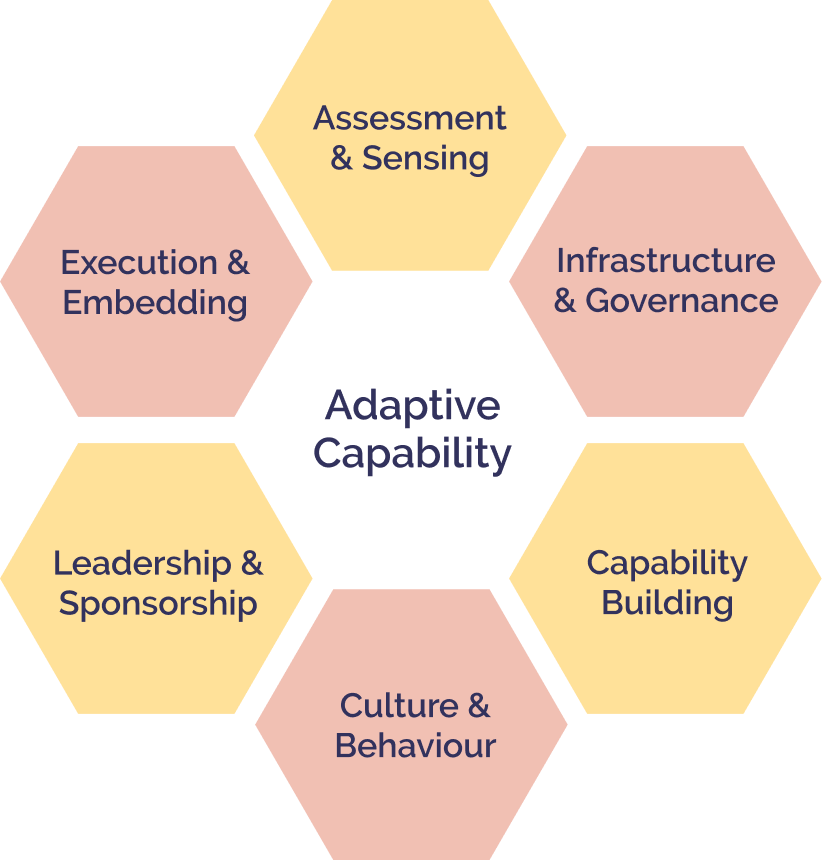
The ACE (Adaptive Capability Ecosystem) approach synthesizes proven change management methodologies and organizational capability frameworks used by leading companies worldwide, identifying six critical dimensions that enable organizations to thrive through continuous transformation.
A Critical Foundation for Transformation Success
Organizations with strong adaptive capability don't just survive change…they thrive through it. The infrastructure for managing continuous transformation has emerged as one of the most important determinants of competitive advantage in today's volatile business environment.
Without sensing and capacity management, organizations overcommit and guarantee failure. Without governance and coordination, changes conflict and overwhelm stakeholders. Without internal capability building, consultant dependency drains resources. Without cultural embedding, even well-executed changes fail to stick. Strong adaptive capability enables proactive, strategic approach to transformation that delivers lasting value.

Sustainable transformation isn’t about managing individual changes. It’s about embedding adaptability into your organizational DNA. When adaptive capability becomes part of who you are, change becomes a competitive advantage rather than a crisis to survive.
Kelly Brogdon Geyer
The Adaptive Capability Assessment is a diagnostic tool to help you benchmark your organization's infrastructure for managing continuous change.
- 1
What Gets Measured…
By measuring capability across six critical dimensions, you can identify where to focus investment for maximum impact on transformation success and sustainable ROI.
- 2
Strategic and Iterative
Use this assessment initially to establish your baseline, then reassess every 6-12 months to measure progress. You'll be able to track capability maturation and the impact on transformation success rates, cultural change, and consultant dependency reduction over time.
- 3
Designing Your Transformation
Using these concrete, measurable dimensions, your leadership team will be able to agree on the highest-impact areas for capability building. Together, you'll design a strategic roadmap with specific practices to implement and commitments to adopt, creating accountability for building adaptive capability.
Sample Questions
Assessment & Sensing
Our organization has clear visibility into all major changes happening across teams and departments.
Infrastructure & Governance
We have formal governance structures (e.g., a Change Council) that coordinate changes across the organization.
Capability Building
We have internal people with the skills to lead change initiatives without heavy reliance on external consultants.
Culture & Behavior
People in our organization generally view change as an opportunity for improvement rather than a disruption to avoid.
Leadership & Sponsorship
Our executive leaders actively sponsor changes throughout the full implementation lifecycle, not just at launch.
Execution & Embedding
We measure actual adoption and behavior change, not just whether changes went live on schedule.
Related Assessments
'%3e%3cpath%20d='M15.9541%200.672852H54.0459C62.4853%200.673027%2069.327%207.5147%2069.3271%2015.9541V54.0459C69.327%2062.4853%2062.4853%2069.327%2054.0459%2069.3271H15.9541C7.5147%2069.327%200.673023%2062.4853%200.672852%2054.0459V15.9541C0.673026%207.5147%207.5147%200.673021%2015.9541%200.672852Z'%20fill='white'%20stroke='%23E0E3EA'%20stroke-width='1.34615'/%3e%3cpath%20d='M48.694%2039.4615L43.3483%2031.1901C42.8105%2031.1809%2042.0586%2031.149%2041.0924%2031.0944V39.4615H37.401V19.4323C37.6015%2019.4323%2038.3717%2019.4003%2039.7115%2019.3365C41.0514%2019.2636%2042.1315%2019.2272%2042.9518%2019.2272C48.0377%2019.2272%2050.5807%2021.1959%2050.5807%2025.1334C50.5807%2026.3183%2050.2298%2027.3984%2049.528%2028.3737C48.8261%2029.3489%2047.942%2030.0371%2046.8756%2030.4381L52.7955%2039.4615H48.694ZM41.0924%2022.5221V28.0865C41.7487%2028.1412%2042.25%2028.1686%2042.5963%2028.1686C44.082%2028.1686%2045.1666%2027.9589%2045.8502%2027.5397C46.5429%2027.1204%2046.8893%2026.3046%2046.8893%2025.0924C46.8893%2024.108%2046.5201%2023.4199%2045.7819%2023.028C45.0436%2022.636%2043.8815%2022.4401%2042.2955%2022.4401C41.9127%2022.4401%2041.5117%2022.4674%2041.0924%2022.5221Z'%20fill='%23FF8760'/%3e%3cpath%20d='M33.3099%2020.4987L31.847%2023.4381C31.0541%2022.6451%2029.778%2022.2487%2028.0189%2022.2487C26.351%2022.2487%2024.9838%2022.9505%2023.9174%2024.3541C22.851%2025.7487%2022.3177%2027.5169%2022.3177%2029.6588C22.3177%2031.8007%2022.8099%2033.5006%2023.7943%2034.7584C24.7878%2036.0162%2026.1094%2036.6451%2027.7592%2036.6451C29.6459%2036.6451%2031.1224%2035.9707%2032.1888%2034.6217L33.8431%2037.4928C32.3939%2039.0332%2030.2702%2039.8033%2027.472%2039.8033C24.6739%2039.8033%2022.5%2038.8828%2020.9506%2037.0416C19.4011%2035.2005%2018.6263%2032.6894%2018.6263%2029.5084C18.6263%2026.5462%2019.4831%2024.0716%2021.1967%2022.0846C22.9193%2020.0885%2025.1205%2019.0905%2027.8002%2019.0905C30.097%2019.0905%2031.9336%2019.5599%2033.3099%2020.4987Z'%20fill='%23FF8760'/%3e%3cpath%20d='M70%2054.0454C70%2062.8567%2062.8571%2069.9993%2054.0459%2069.9995H15.9541C7.14287%2069.9993%200%2062.8567%200%2054.0454V51.1538H70V54.0454Z'%20fill='%23FF8760'/%3e%3c/g%3e%3cdefs%3e%3cclipPath%20id='clip0_4732_48'%3e%3crect%20width='70'%20height='70'%20fill='white'/%3e%3c/clipPath%3e%3c/defs%3e%3c/svg%3e)
Top Features

Leverage a proven, evidence-based approach to quickly identify where your organization needs attention and initiate strategic conversations about building sustainable adaptive capability.
Gain insights expeditiously: perform analysis at the team, program and organizational levels to understand capability maturity and prioritize investments.
Give your leadership team a voice and allow them to express where you can do the most good for your organization through strategic capability investment.
Benchmark your level of adaptive capability across your teams and organization against other organizations in your industry.
Kelly helps organizations turn constant change into strategic advantage. With over 20 years leading enterprise transformations across the globe, Kelly has helped thousands of professionals navigate change successfully.
Originally from the United States and now based in Austria, Kelly’s experience spans technical implementations, M&A integrations, and cultural transformations.
Kelly holds multiple certifications including CCMP. She’s developed proprietary methodologies including the Momentum TransforMate Ecosystem (MTE) and PATH Framework, bringing practical, proven approaches to help organizations build change capability that drives sustainable transformation results.
'%3e%3cg%20opacity='0.5'%3e%3cpath%20fill-rule='evenodd'%20clip-rule='evenodd'%20d='M6.05554%2024.5C6.82259%2014.1549%2015.459%206%2026.0001%206C24.3384%206%2022.8589%206.72842%2021.6417%207.84225C20.4307%208.95051%2019.4073%2010.4976%2018.5795%2012.3263C17.7469%2014.1658%2017.1001%2016.3174%2016.6624%2018.6522C16.3115%2020.5239%2016.0979%2022.497%2016.0268%2024.5H6.05554ZM6.05554%2027.5H16.0268C16.0979%2029.503%2016.3115%2031.4761%2016.6624%2033.3478C17.1001%2035.6826%2017.7469%2037.8342%2018.5795%2039.6737C19.4073%2041.5024%2020.4307%2043.0495%2021.6417%2044.1577C22.8589%2045.2716%2024.3384%2046%2026.0001%2046C15.459%2046%206.82259%2037.8451%206.05554%2027.5Z'%20fill='%23193A74'/%3e%3cpath%20d='M26.0001%206C27.6619%206%2029.1414%206.72842%2030.3585%207.84226C31.5696%208.95051%2032.593%2010.4976%2033.4207%2012.3263C34.2534%2014.1658%2034.9001%2016.3174%2035.3379%2018.6522C35.6888%2020.5239%2035.9023%2022.497%2035.9735%2024.5H45.9447C45.1777%2014.1549%2036.5413%206%2026.0001%206Z'%20fill='%23193A74'/%3e%3cpath%20d='M35.3379%2033.3478C34.9001%2035.6826%2034.2534%2037.8342%2033.4207%2039.6737C32.593%2041.5024%2031.5696%2043.0495%2030.3585%2044.1577C29.1414%2045.2716%2027.6619%2046%2026.0001%2046C36.5413%2046%2045.1777%2037.8451%2045.9447%2027.5H35.9735C35.9024%2029.503%2035.6888%2031.4761%2035.3379%2033.3478Z'%20fill='%23193A74'/%3e%3cg%20opacity='0.5'%3e%3cpath%20d='M26.0002%208.79102C25.4502%208.79102%2024.7397%209.02505%2023.9134%209.78115C23.0811%2010.5428%2022.2479%2011.7366%2021.5117%2013.3631C20.7804%2014.9787%2020.1866%2016.9291%2019.7779%2019.1087C19.4561%2020.8252%2019.2565%2022.6447%2019.1864%2024.5003H32.8141C32.744%2022.6447%2032.5444%2020.8252%2032.2226%2019.1087C31.8139%2016.9291%2031.2201%2014.9787%2030.4888%2013.3631C29.7526%2011.7366%2028.9194%2010.5428%2028.087%209.78115C27.2608%209.02505%2026.5503%208.79102%2026.0002%208.79102Z'%20fill='%23193A74'/%3e%3cpath%20d='M19.7779%2032.8919C20.1866%2035.0715%2020.7804%2037.0219%2021.5117%2038.6376C22.2479%2040.264%2023.0811%2041.4578%2023.9134%2042.2195C24.7397%2042.9756%2025.4502%2043.2096%2026.0002%2043.2096C26.5503%2043.2096%2027.2608%2042.9756%2028.087%2042.2195C28.9194%2041.4578%2029.7526%2040.264%2030.4888%2038.6376C31.2201%2037.0219%2031.8139%2035.0715%2032.2226%2032.8919C32.5444%2031.1755%2032.744%2029.3559%2032.8141%2027.5003H19.1864C19.2565%2029.3559%2019.4561%2031.1755%2019.7779%2032.8919Z'%20fill='%23193A74'/%3e%3c/g%3e%3c/g%3e%3c/g%3e%3cdefs%3e%3cclipPath%20id='clip0_612_654'%3e%3crect%20width='52'%20height='52'%20fill='white'/%3e%3c/clipPath%3e%3c/defs%3e%3c/svg%3e)
