Empowering Agile Coaching with Comparative Agility Data
Introduction
Agile coaches are essential change agents in the pursuit of enterprise agility. Yet, coaching success often hinges on having access to real-time team insights, organizational alignment data, and trusted benchmarks. A recent study conducted by University of Oslo and SINTEF (a leading EU research organization) reveals how Agile Coaches used Comparative Agility's data platform to guide and measure coaching effectiveness across the enterprise.
Key areas where Comparative Agility supported agile coaching efforts:

Team assessments
that guided coaching conversations.

Benchmarking team maturity
against global industry standards.

Identifying and addressing structural and cultural barriers
to agility.

Driving continuous improvement
across both team and enterprise levels.
Comparative Agility scores at the start and after several months
This use case explores how Comparative Agility helped Agile Coaches foster self managing teams and improve leadership support, ultimately enabling sustainable, organization wide agility.
Developing High-Functioning Teams Through Data
One of the core responsibilities of Agile Coaches is supporting the development of autonomous, self-managing teams. However, building autonomy requires more than just encouragement—it demands structured feedback, visibility into team dynamics, and alignment with broader organizational goals.

Top Barriers to Team Autonomy Identified
These were common themes uncovered by the coaches using Comparative Agility data.
Dependency on management for decisions
4.6
High workload/stress levels
4.3
Lack of time for learning
4.1
Unstable team composition
3.7
Role ambiguity
3.6
Using Comparative Agility's assessments, coaches in the study were able to:
Evaluate team morale, psychological safety, and shared understanding.
Use data trends to guide tailored coaching interventions.
Help teams reflect on their own performance using objective metrics, not assumptions.
These insights made coaching conversations more focused and impactful, enabling teams to own their growth journey and move toward higher maturity levels in a structured way.
Aligning Coaching Strategy with Organizational Needs
In complex enterprises, team-level change must be mirrored by shifts at the organizational and leadership levels. Coaches often struggle to bridge that gap. The study shows how Comparative Agility enabled coaches to:
Spot misalignments between organizational expectations and team reality.

Communicate data-backed feedback to leadership.

Elevate issues such as team overload, unclear vision, or lack of structural support.
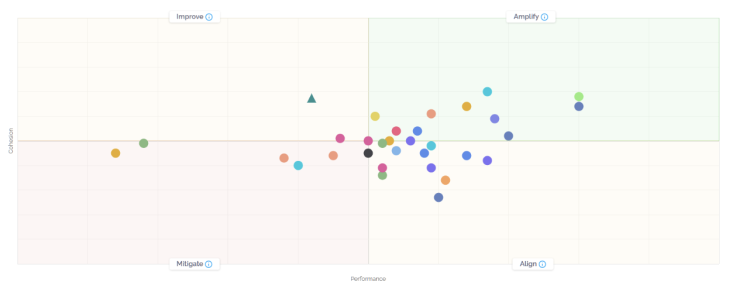
Comparative Agility maps teams into quadrants to identify where coaching support is needed and where teams have established autonomy.
By quantifying patterns across multiple teams, Comparative Agility empowered coaches to engage leaders with clear evidence and advocate for systemic changes—like role clarity, time allocation for learning, and stable team compositions—that supported real autonomy.
Making Coaching Measurable and Scalable
A major challenge in coaching is showing measurable progress, especially when operating across dozens of teams. Comparative Agility provided a scalable framework for ongoing measurement and benchmarking, which helped:

Track improvements in collaboration, team stability, and knowledge-sharing.
Create a feedback loop for coaching effectiveness.
Prioritize where to focus limited coaching capacity based on team health data.
Effort
(motivation, psychological safety)
Strategies
(collaboration norms, retrospectives)
Knowledge & Skills
(learning culture, cross-functionality)
Organizational Alignment
(leadership support, stable environment)
For example, some teams in the study exhibited low psychological safety and shared understanding, signalling a need for deeper
intervention. Others showed strong results, allowing coaches to shift their attention to teams needing more support.
This approach allowed Agile Coaches to move from reactive to strategic, using Comparative Agility's data as a compass for long-term
transformation.
Why This Matters for Universities, Research, and Beyond
The organization behind this study operates in a highly regulated, complex environment—where innovation, quality, and speed directly impact human lives. These same pressures are increasingly felt in academic institutions and research organizations, where cross-functional collaboration, continuous improvement, and evidence-based decision-making are critical to advancing knowledge and delivering meaningful outcomes.
Comparative Agility provides the tools to:
Identify team barriers to autonomy early.

Enable meaningful retrospectives and decision-making.
Inform leadership about where organizational change was needed.
Support evidence-based coaching practices grounded in data.
These lessons are equally relevant to any industry undergoing Agile transformation. Whether in healthcare, finance, or tech, Comparative Agility empowers coaches to scale their impact with data-driven clarity.
Conclusion
As Agile Coaches play an increasingly strategic role in enterprise transformation, the ability to anchor their work
in data, track progress, and align with organizational goals is essential.
This use case demonstrates that Comparative Agility is more than just a measurement tool—it's a trusted coaching partner that helps
coaches:
• Develop autonomous teams.
• Drive cultural and structural alignment.
• Show the ROI of coaching efforts.